
Bridge safety depends on regular inspections that can identify structural problems before they become serious. Since damaging a bridge during inspection is impractical and costly, engineers rely on non-destructive testing (NDT) methods to assess concrete quality, detect hidden defects, and evaluate reinforcement conditions. Choosing the right Concrete Testing Equipment is essential for obtaining accurate and reliable inspection results.
Among the most widely used NDT techniques for bridge inspection are the rebound hammer test, ultrasonic testing, and Ground Penetrating Radar (GPR). Each method offers unique advantages and is designed for specific inspection objectives. This article compares these three technologies to help engineers, contractors, and infrastructure managers determine the best solution for their projects while highlighting how HBJF provides professional Concrete Testing Equipment for comprehensive bridge assessments.
Bridges are continuously exposed to heavy traffic loads, weather changes, moisture, deicing salts, and environmental pollutants. Over time, these factors can cause concrete deterioration, reinforcement corrosion, and structural damage.
Traditional destructive testing methods require drilling or coring, which can weaken structural components and disrupt traffic. In contrast, non-destructive testing allows inspectors to evaluate bridge conditions without damaging the structure.
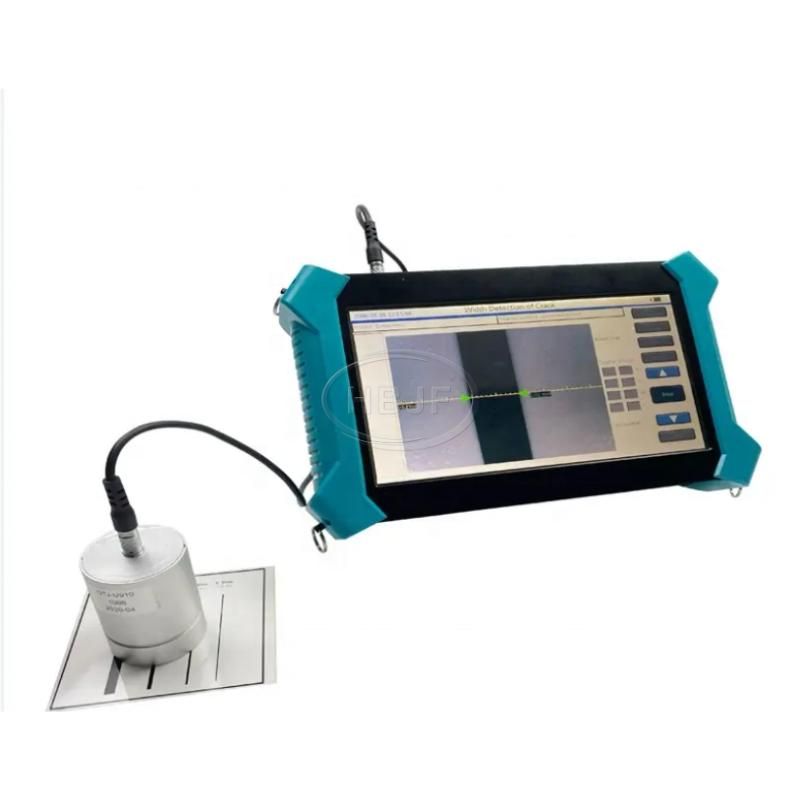
Modern Concrete Testing Equipment enables engineers to:
Estimate the compressive strength of hardened concrete without removing samples.
Identify cracks, voids, honeycombing, and delamination hidden beneath the surface.
Determine the position, spacing, and concrete cover of reinforcing bars before maintenance or repair.
Accurate inspection data helps prioritize repairs and reduce long-term maintenance costs.
The rebound hammer, also known as the Schmidt hammer, is one of the simplest and most widely used concrete inspection tools.
The instrument strikes the concrete surface with a spring-loaded mass and measures the rebound distance. Harder concrete produces a higher rebound value, which correlates with compressive strength.
· Fast and easy to perform
· Portable and lightweight
· Cost-effective for routine inspections
· Minimal operator training required
· Suitable for large inspection areas
Although rebound testing is useful for estimating surface hardness, it only evaluates the outer layer of concrete.
Results can be influenced by:
· Surface roughness
· Moisture content
· Carbonation
· Aggregate type
· Concrete age
Therefore, rebound testing should not be the sole method for assessing bridge integrity.
Ultrasonic testing evaluates the internal quality of concrete by measuring the speed of ultrasonic waves traveling through the material.
A transmitter sends ultrasonic pulses into the concrete while a receiver measures the travel time. Sound waves move faster through dense, intact concrete than through damaged or cracked areas.
Ultrasonic Concrete Testing Equipment can:
· Detect internal cracks
· Identify voids and honeycombing
· Evaluate concrete uniformity
· Measure crack depth
· Assess structural integrity
Unlike rebound testing, ultrasonic inspection provides information about the internal condition of the concrete.
Ultrasonic testing requires good contact between the transducers and the concrete surface.
Its accuracy may decrease when:
· Reinforcement is densely arranged
· Surface conditions are poor
· Access is limited to one side of the structure
Proper interpretation also requires experienced operators.
Ground Penetrating Radar is one of the most advanced bridge inspection technologies available today.
GPR transmits high-frequency electromagnetic waves into concrete. When the waves encounter reinforcing steel, voids, moisture, or other material changes, they reflect back to the antenna, creating an image of subsurface conditions.
GPR provides information that other NDT methods cannot easily obtain.
It can:
· Locate reinforcing bars
· Measure concrete cover depth
· Detect post-tensioning ducts
· Identify voids
· Find delamination
· Map embedded utilities
· Inspect bridge decks rapidly
Large bridge surfaces can be scanned quickly, making GPR ideal for highway infrastructure inspections.
GPR does not directly measure concrete strength.
Additionally, interpretation requires specialized software and experienced analysts. Moisture and highly conductive materials can also affect signal quality.
Choosing the right Concrete Testing Equipment depends on the inspection objective.
Best for:
· Estimating surface compressive strength
· Routine quality control
· Preliminary bridge inspections
Not ideal for:
· Detecting internal defects
· Locating reinforcement
Best for:
· Evaluating internal concrete quality
· Detecting cracks and voids
· Assessing structural integrity
Not ideal for:
· Mapping reinforcement across large bridge decks
· Rapid large-area scanning
Best for:
· Locating reinforcing steel
· Measuring concrete cover
· Detecting delamination
· Large bridge deck inspections
Not ideal for:
· Measuring concrete compressive strength directly
Absolutely. In fact, combining multiple NDT techniques often produces the most accurate bridge assessment.
For example:
Engineers frequently combine rebound hammer and ultrasonic testing to estimate concrete strength more accurately than either method alone.
Ultrasonic testing detects internal defects, while GPR identifies reinforcement location and concrete cover.
This combination provides both surface strength information and reinforcement mapping before rehabilitation work.
Integrated inspections allow engineers to obtain a complete understanding of bridge condition while minimizing uncertainty.
When selecting inspection instruments, consider the following factors:
Determine whether the goal is to measure strength, detect defects, or locate reinforcement.
Large bridge decks often benefit from high-speed GPR systems, while localized inspections may only require rebound or ultrasonic testing.
Rebound hammers are the most economical option, while GPR systems require a higher initial investment but offer broader inspection capabilities.
Advanced equipment like ultrasonic and GPR systems typically requires specialized training for accurate data interpretation.
HBJF offers a comprehensive range of professional Concrete Testing Equipment designed for infrastructure inspection, construction quality control, and structural evaluation.
HBJF combines modern sensing technologies with precise measurement systems to deliver dependable inspection results.
Each instrument is engineered to provide consistent performance for demanding bridge inspection projects.
Built for challenging field conditions, HBJF equipment withstands daily use on construction sites and infrastructure projects.
HBJF supplies:
· Rebound hammers
· Ultrasonic concrete testers
· Rebar locators
· Concrete cover meters
· Integrated NDT inspection systems
This allows engineers to select the most appropriate solution for every inspection task.
HBJF provides product guidance, technical assistance, and training resources to help inspection teams maximize equipment performance.
There is no single NDT method that fits every bridge inspection scenario. Rebound hammer testing is ideal for quickly estimating surface concrete strength, ultrasonic testing excels at identifying internal defects and evaluating concrete quality, while Ground Penetrating Radar provides unmatched capabilities for locating reinforcement and detecting hidden subsurface features.
For the most reliable bridge assessments, many engineers combine these technologies to obtain comprehensive structural data. By investing in high-quality Concrete Testing Equipment from HBJF, inspection professionals can improve diagnostic accuracy, extend bridge service life, and make informed maintenance decisions that enhance public safety and reduce long-term infrastructure costs.
Previous: What Is the Micro-Deval Test and What Machine Specs Matter Most?
Next: How to Detect Rebar Cover Depth with a Steel Bar Testing Instrument?
Copyright:@2020-2021

Comments Please sign in or sign up to post.
0
0 of 500 characters used