
Modern homeowners expect more from their heating and cooling systems than ever before. Comfort, energy efficiency, remote access, and smart home integration have become standard expectations rather than luxury features.
As a result, the wifi smart thermostat has become one of the fastest-growing categories in residential HVAC technology. Compared with traditional programmable thermostats, modern smart thermostats offer greater control, better comfort management, and improved energy efficiency.
An increasing number of homeowners are also choosing systems that include remote room sensors, allowing temperature control decisions to be based on multiple rooms instead of a single thermostat location.
Understanding how these technologies work can help homeowners choose the right solution for their homes.
A wifi smart thermostat is an internet-connected device that controls heating and cooling equipment while allowing users to monitor and adjust settings remotely through a smartphone application or web platform.
Unlike traditional thermostats, smart models can:
Create detailed schedules
Adjust temperatures remotely
Monitor HVAC performance
Track energy usage
Provide maintenance reminders
Integrate with smart home ecosystems
Support voice assistants
Many modern systems also include advanced comfort management features that improve temperature consistency throughout the home.
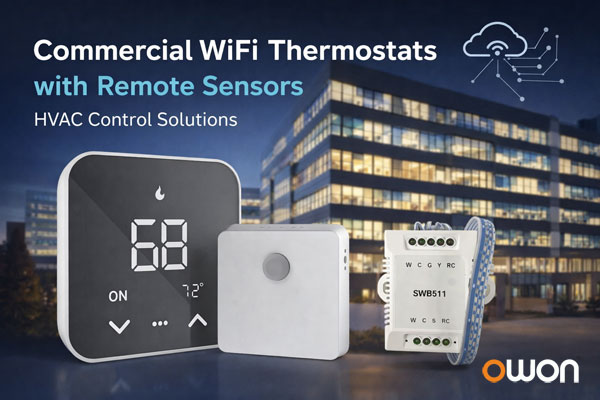
Every thermostat acts as the control center of a home's HVAC system.
When room temperatures move above or below the desired setpoint, the thermostat sends signals to heating or cooling equipment such as:
Furnaces
Air conditioners
Heat pumps
Boilers
Fan systems
The thermostat continuously monitors temperature conditions and activates equipment only when needed.
A smart thermostat performs the same function while adding scheduling, connectivity, automation, and reporting capabilities that improve both convenience and efficiency.
One of the biggest limitations of conventional thermostats is their fixed location.
Most thermostats are installed in a hallway or central living area. Unfortunately, temperatures can vary significantly throughout a home.
Factors that influence room temperatures include:
Window orientation
Sun exposure
Room occupancy
Insulation quality
Ceiling height
HVAC duct layout
As a result, one room may feel comfortable while another feels too warm or too cold.
This issue is especially common in:
Two-story homes
Large open floor plans
Homes with finished basements
Homes with large south-facing windows
A remote sensor thermostat uses additional wireless sensors placed in different rooms throughout the home.
Instead of relying solely on the thermostat's internal sensor, the system can collect temperature information from multiple locations.
This approach allows HVAC equipment to respond to actual living conditions throughout the home rather than conditions in a single hallway.
Benefits include:
Reduced hot and cold spots
More balanced comfort
Better temperature accuracy
Improved sleep comfort
More efficient HVAC operation
Many homeowners consider remote sensors one of the most valuable smart thermostat features available today.
Many homeowners initially purchase a wifi smart thermostat for convenience but later discover significant energy-saving benefits.
Smart thermostats help reduce waste by:
Lowering temperatures when occupants are away
Automatically resuming comfort settings before arrival
Optimizing heating and cooling cycles
Preventing unnecessary HVAC runtime
Identifying unusual energy consumption patterns
According to multiple energy-efficiency programs across North America, properly configured smart thermostats can help reduce annual heating and cooling costs under the right operating conditions.
Another reason for growing adoption is smart home connectivity.
Today's wifi smart thermostat platforms often integrate with:
Amazon Alexa
Google Assistant
Smart lighting systems
Occupancy sensors
Door and window sensors
Home energy management systems
These integrations enable more advanced automation scenarios.
For example:
Lower heating when everyone leaves home
Pause cooling when windows are opened
Resume comfort settings before occupants return
Such automation helps improve both convenience and efficiency.
Many homeowners assume smart thermostats only work with newer HVAC systems.
In reality, many models support:
Conventional furnaces
Central air conditioning systems
Heat pumps
Dual fuel systems
Hybrid heating systems
Boiler-based systems
Before purchasing any thermostat, homeowners should verify compatibility with their specific HVAC equipment and wiring configuration.
Not all thermostats offer the same capabilities.
Important factors include:
Confirm support for your heating and cooling equipment.
Remote sensors can dramatically improve comfort in larger homes.
Look for advanced daily and weekly scheduling options.
Usage reports help identify opportunities for savings.
Choose a thermostat compatible with your preferred ecosystem.
Support for additional sensors and automation features can provide long-term value.
The smart thermostat market continues to evolve rapidly.
Newer systems increasingly incorporate:
Occupancy sensing
Humidity management
Dual fuel optimization
Energy reporting
Wireless room sensors
Mobile-first control platforms
Many homeowners now view thermostats as an important component of broader home energy management strategies.
For those evaluating advanced HVAC control solutions, products offered by a wifi thermostat supplier can provide examples of how remote sensing, smart scheduling, and connected control technologies are being implemented in modern residential HVAC systems.
The modern wifi smart thermostat has evolved far beyond simple temperature control.
By combining remote access, intelligent scheduling, energy monitoring, and remote room sensing, today's systems help homeowners achieve better comfort while reducing unnecessary energy consumption.
For homes that experience uneven temperatures, a remote sensor thermostat can provide an additional level of comfort by ensuring heating and cooling decisions reflect conditions throughout the home rather than a single thermostat location.
Previous: How to Choose Starlink Mini Power Cable Lengths to Reduce Voltage Drop in Field Installs
Next: Vending Machine with Healthy Food: What Products Actually Sell Well?
Copyright:@2020-2021

Comments Please sign in or sign up to post.
0
0 of 500 characters used