
The long-term stability of embankments, highways, railways, dams, and retaining structures depends heavily on the shear strength of the underlying soil. If soil cannot resist shear stresses, it may experience excessive deformation, slope failure, or even catastrophic collapse. To accurately evaluate this critical property, engineers rely on a triaxial apparatus—one of the most advanced tools used in geotechnical laboratories.
As an essential component of professional Soil Test Equipment, a triaxial apparatus provides precise measurements of soil behavior under controlled stress conditions. The results help engineers design safe embankments, optimize construction methods, and ensure compliance with engineering standards. In this article, we'll explore how a triaxial apparatus works, its testing procedures, and why HBJF offers reliable Soil Test Equipment for geotechnical testing.
A triaxial apparatus is laboratory equipment used to determine the shear strength and deformation characteristics of soil by applying controlled axial and confining pressures to a cylindrical soil specimen.
Unlike simple compression tests, the triaxial test simulates real-world underground stress conditions, making it one of the most reliable methods for evaluating soil performance in embankment construction.
Engineers use triaxial testing to analyze:
· Shear strength
· Cohesion (c)
· Angle of internal friction (φ)
· Stress-strain behavior
· Pore water pressure
· Soil stiffness
· Failure mechanisms
These parameters are fundamental for designing stable earth structures.
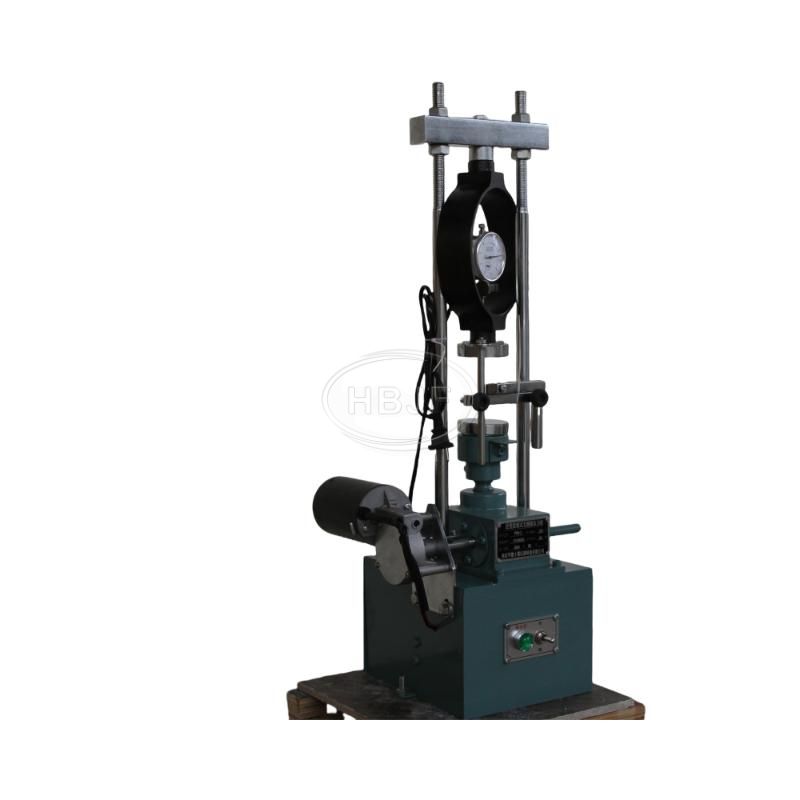
An embankment continuously experiences vertical loads from its own weight, traffic, and environmental conditions. At the same time, lateral forces develop within the soil mass.
If the soil's shear strength is insufficient, problems may occur, including:
Weak soil may slide along failure surfaces, causing embankment collapse.
Poor shear resistance allows soil particles to rearrange, leading to uneven settlement.
Insufficient strength can produce surface cracking that shortens pavement service life.
Accurate shear strength measurements help engineers calculate adequate safety factors for long-term stability.
The triaxial test recreates field stress conditions inside a controlled laboratory environment.
A cylindrical soil sample is carefully trimmed to standard dimensions.
The specimen is enclosed in a flexible rubber membrane to prevent direct contact with the surrounding fluid.
The specimen is positioned between loading platens inside the triaxial chamber.
The chamber is then filled with water or oil to create confining pressure around the sample.
The apparatus applies uniform pressure from all directions except the top and bottom.
This simulates the natural pressure exerted by surrounding soil in the field.
Different confining pressures can represent varying depths below ground.
A vertical load is gradually applied to the specimen until failure occurs.
During loading, the system continuously records:
· Axial force
· Axial displacement
· Stress
· Strain
· Pore water pressure (when applicable)
After the specimen fails, engineers analyze the recorded data to calculate shear strength parameters used in embankment design.
Different project requirements call for different testing methods.
The UU test is the fastest method.
Characteristics include:
· No consolidation
· No drainage
· Suitable for saturated cohesive soils
· Commonly used for rapid construction assessments
The CU test allows soil consolidation before shearing while preventing drainage during loading.
Advantages include:
· Measures pore water pressure
· Simulates many field conditions
· Frequently used in embankment and foundation design
The CD test allows complete drainage throughout testing.
It is suitable for:
· Long-term stability analysis
· Granular soils
· Permanent embankment structures
Although slower than other methods, it provides highly reliable long-term strength parameters.
The triaxial apparatus evaluates the stress conditions at soil failure.
Using the recorded axial and confining stresses, engineers determine:
Cohesion represents the bonding force between soil particles.
Clay soils generally exhibit higher cohesion than sands.
The friction angle indicates the resistance generated by particle interlocking during shearing.
Granular soils usually have higher friction angles.
By testing several specimens under different confining pressures, engineers establish the Mohr-Coulomb failure envelope.
This relationship predicts soil behavior under various loading conditions encountered in embankments.
The triaxial apparatus supports numerous geotechnical applications.
Determine whether foundation soils can safely support pavement loads.
Evaluate embankment stability under repeated train loading.
Analyze long-term shear resistance and seepage effects.
Provide design parameters for lateral earth pressure calculations.
Supply accurate strength values for slope safety calculations.
Compared with many traditional soil tests, triaxial testing offers significant benefits.
The apparatus closely reproduces actual underground stress conditions.
It measures both strength and deformation properties.
Modern digital systems produce precise and repeatable results.
Suitable for cohesive soils, granular soils, stabilized materials, and engineered fills.
Triaxial testing complies with widely recognized ASTM, AASHTO, ISO, and BS standards.
Although the triaxial apparatus provides comprehensive strength data, engineers often combine it with other Soil Test Equipment for a complete site evaluation.
Determines optimum moisture content and maximum dry density.
Evaluates subgrade support capacity for pavement design.
Provides rapid field estimates of soil strength.
Measures in-situ bearing capacity and settlement characteristics.
Using multiple testing methods improves design reliability and construction quality.
Reliable laboratory results require precision-engineered equipment. HBJF offers a complete range of Soil Test Equipment for geotechnical laboratories, universities, construction companies, and research institutions.
Key advantages include:
HBJF equipment delivers accurate, repeatable measurements that support confident engineering decisions.
Products are manufactured in accordance with ASTM, AASHTO, ISO, and other recognized testing specifications.
High-quality materials ensure dependable operation in demanding laboratory environments.
Modern control systems simplify testing procedures and improve laboratory efficiency.
Beyond triaxial apparatus systems, HBJF supplies equipment for soil mechanics, asphalt, concrete, cement, aggregate, and foundation testing, enabling customers to establish complete materials testing laboratories.
A triaxial apparatus is one of the most valuable tools for determining the shear strength of soils used in embankments. By simulating real-world stress conditions and measuring key parameters such as cohesion and internal friction angle, it provides engineers with the data needed to design safe, stable, and durable earth structures.
As a critical component of professional Soil Test Equipment, triaxial testing improves the accuracy of geotechnical investigations and supports better engineering decisions. With advanced testing solutions from HBJF, laboratories and construction professionals can perform reliable shear strength testing, ensuring embankments meet the highest standards of safety, performance, and long-term stability.
Previous: Penetration Rate and Energy Efficiency Differences Between Top-Hammer and DTH Drilling Rigs
Next: Air-Cooled vs Water-Cooled Flake Ice Machines: Efficiency and Installation Differences
Copyright:@2020-2021

Comments Please sign in or sign up to post.
0
0 of 500 characters used