
Stockpile management is one of the most overlooked cost centers in mining and quarry operations. The choice between a telescopic stacker and a fixed stacking conveyor determines how much ground you can cover from one feed point, how often you need to move equipment, and how much loader work is required to manage the piles.
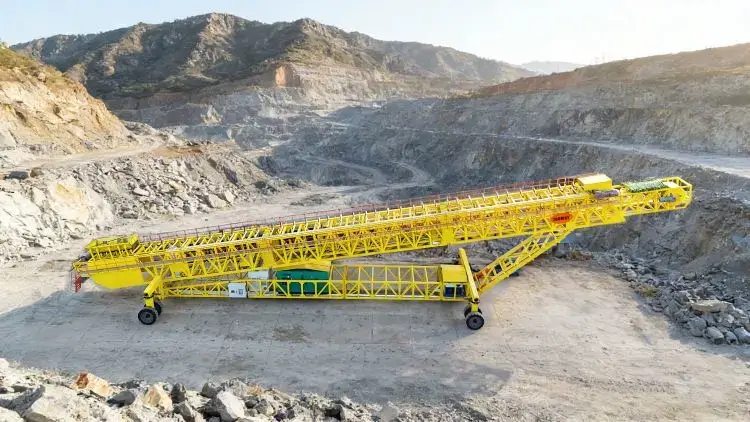
This article compares the two approaches for operators evaluating stockyard equipment.
A fixed stacking conveyor discharges material from a stationary position. It builds a single conical pile or a narrow linear window. The structure is simple, the capital cost is low, and maintenance is straightforward — fewer bearings, fewer drives, fewer things to go wrong.
For operations with one material type and a stable stockpile location, this simplicity makes sense. The pile forms in the same place every day, and downstream reclaiming equipment can be positioned to match.
The limitation shows up when the stockpile grows. A single conical pile covers a limited area, and the material quickly reaches the maximum height the conveyor can discharge. To build additional stockpiles, you either relocate the entire conveyor or bring in wheel loaders to reshape and move material.
That loader work is expensive. Every ton re-handled by loader costs fuel, labor, and machine hours — costs that disappear when the stacking equipment covers more ground on its own.
A telescopic stacker addresses the coverage problem through two mechanisms: radial slewing and telescopic boom extension.
The boom rotates around the tail pivot, sweeping an arc of up to 360 degrees. The telescopic section extends and retracts, moving the discharge point along the stockpile length. Together, these functions allow one machine to build fan-shaped stockpiles covering a wide area from a single feed position.
The result is more material stored per square meter of yard space, less loader re-handling, and fewer equipment relocations during the production day.
Telescopic stackers also improve material quality through layered stacking. By adjusting the discharge height and moving the discharge point across the pile, the operator distributes fine and coarse particles more evenly through the stockpile profile.
Single-point dumping creates segregation — coarse material rolls to the outside while fines stay in the center. Layered stacking reduces this effect, producing more uniform material for downstream processing.
Fixed stacking conveyor wins when there is one stockpile location, one material type, and the pile size stays within the fixed discharge reach
Telescopic stacker wins when the yard needs multiple stockpiles, the material types change, or loader dependency is eating into operating margins
For most mid-sized quarry and mining stockyards, the telescopic stacker pays for itself through reduced loader hours and better use of available yard space. The higher upfront cost is offset by lower operating cost per ton stored.
Copyright:@2020-2021

Comments Please sign in or sign up to post.
0
0 of 500 characters used