
When you walk into a retail store or scroll through an online boutique, the knitwear on display looks polished and intentional. But behind every successful private-label sweater line is a series of decisions made months earlier — yarn weight, stitch structure, fit specifications, trim details. If you are a brand owner or purchasing agent sourcing OEM women's knitwear, the range of customization options can feel overwhelming. You need to know exactly what levers you can pull to create a garment that matches your price point, your target customer, and your delivery timeline.
Traditional approaches often treat knitwear as a commodity: pick a stock style, add a label, done. That approach leaves money on the table. A well-executed OEM program lets you differentiate your line without reinventing the supply chain. This article walks through every major customization category — from fiber selection to finishing details — so you can brief your factory with confidence. We cover what is realistically achievable in production runs of 500 to 5,000 pieces, based on industry-standard knitwear manufacturing capabilities.
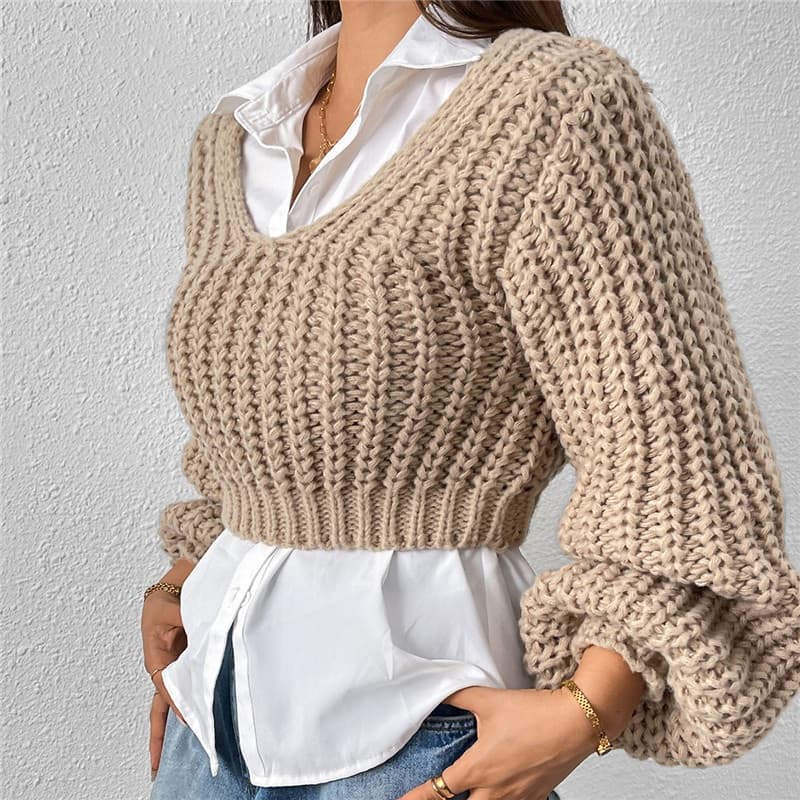
Fiber selection drives 40–60% of garment cost; choose between natural, synthetic, and blended yarns based on your target retail price and climate.
Gauge (needle count per inch) determines fabric density and drape; common women's knitwear gauges range from 3-gauge chunky to 12-gauge fine knits.
Silhouette customization includes body length, sleeve type, neckline shape, and hem finish — each affects both fit and production complexity.
Color matching via Pantone TPX standards ensures batch-to-batch consistency; most factories accept a 48-hour turnaround for lab dips.
Trim and embellishment options — buttons, zippers, embroidery, beadwork — add 15–30% to unit cost but can double perceived value.
Before you contact a factory, gather these three things. First, a clear target price point. Second, a size specification sheet (or at least a reference garment). Third, a Pantone or physical color reference. Without these, every conversation becomes guesswork.
You also need to decide whether you want a full-package OEM service — where the factory sources yarn, trims, and packaging — or a cut-make-trim arrangement where you supply materials. Most brands prefer full-package for simplicity. Welcome to ZeFeng! As a professional sweater manufacturer, w e handle yarn sourcing, sample development, and bulk production under one roof, which reduces lead time and communication errors.
Make sure your factory has the certifications your target market requires. Common standards include OEKO-TEX Standard 100 for chemical safety, GOTS for organic fibers, and WRAP for social compliance. Ask for certificates before you place your first sample order.
Fiber selection is the single biggest cost and quality lever in knitwear. You have three broad categories:
Natural fibers: Merino wool (18–24 micron), cashmere (14–16 micron), cotton (combed or carded), linen, silk. Merino is the most versatile for women's knitwear — it breathes, resists odor, and can be machine-washed if superwash treated.
Synthetic fibers: Acrylic, nylon, polyester. Acrylic is the most common budget option; it mimics wool at roughly one-third the cost. Nylon adds durability and stretch when blended.
Blends: Wool-acrylic (50/50 or 70/30), cotton-polyester, cashmere-silk. Blends balance cost with performance. A 70% merino / 30% nylon blend is standard for performance knitwear because it retains shape after repeated wear.
For each fiber, specify the yarn count (Nm or Ne) and ply. A 2/28 Nm merino yarn produces a fine 12-gauge knit; a 1/5 Nm chunky yarn produces a 3-gauge sweater. Your factory's yarn supplier will have a standard range, but you can request custom twists or slubs for a textured look.
Fiber choice affects not just hand feel but care instructions, pilling resistance, and dye uptake. A 100% acrylic sweater pills faster than a wool-acrylic blend. A cotton sweater shrinks more in the first wash. If you are selling to a European market that requires OEKO-TEX certification, your yarn must come from a certified mill. According to the International Wool Textile Organisation, merino wool garments retain 80% of their original appearance after 30 washes when properly finished — a data point you can use in your product marketing.
Choosing fiber by price alone: Cheap acrylic knits look good in a sample but degrade after three washes. Your return rate will spike.
Ignoring yarn inventory: Some specialty yarns have 8–12 week lead times. Ask your factory what yarns they stock before finalizing your spec.
Skipping a wear trial: Always have a sample garment worn and washed three times before approving bulk production. This catches shrinkage, pilling, and color bleeding.
Gauge refers to the number of needles per inch on the knitting machine. It directly controls fabric density. Common gauges for women's knitwear:
| Gauge | Needles per inch | Typical Use | Fabric Weight |
|---|---|---|---|
| 3-gauge | 3 | Chunky cardigans, oversized pullovers | Heavy (600–800 g/m²) |
| 5-gauge | 5 | Mid-weight sweaters, cable knits | Medium-heavy (400–600 g/m²) |
| 7-gauge | 7 | Standard pullovers, cardigans | Medium (300–450 g/m²) |
| 12-gauge | 12 | Fine knits, lightweight tops | Light (180–280 g/m²) |
| 14-gauge | 14 | Sheer knits, layering pieces | Very light (120–180 g/m²) |
Stitch structure is your second decision. The most common are jersey (plain knit), rib (1x1 or 2x2 for cuffs and hems), cable, and links-links (purl stitch for reversible fabrics). You can also request intarsia for color-block patterns, jacquard for multi-color motifs, or pointelle for decorative eyelets.
Your factory can produce a stitch card — a small swatch showing 6–10 stitch options — so you can feel the difference before committing. Women's Cardigan Sweater s often use a 5- or 7-gauge structure for body warmth without bulk, while fine-gauge pullovers work better for layering.
Gauge and stitch together determine drape, breathability, and production speed. A 3-gauge sweater takes roughly 45 minutes of machine time per piece; a 12-gauge sweater takes about 20 minutes. That difference adds up across a 1,000-piece order. Also, certain stitches require specific machine types — cable stitches need a transfer machine, while jacquard needs a multi-feed electronic machine. Confirm your factory has the right equipment before you design.
Designing a stitch that your factory cannot produce: Always ask for a machine capability list. Some factories only have flat-bed machines; others have both flat-bed and circular.
Ignoring stitch recovery: Rib stitches snap back after stretching; jersey does not. If your design has a wide neckline, use a ribbed trim to prevent sagging.
Overcomplicating the sample phase: Limit stitch changes to two or three per garment in the first sample. You can add complexity after the fit is approved.
Silhouette customization covers body length, sleeve type, neckline, and hem finish. Provide your factory with a size spec sheet that includes these measurements in centimeters:
Body length (from high point of shoulder to hem)
Chest width (1 inch below armhole)
Waist width (at natural waist)
Sleeve length (from shoulder seam to cuff)
Sleeve width (at bicep)
Neck drop (front and back)
Armhole depth
Common women's knitwear silhouettes include:
Boxy cropped: Body length 48–52 cm, straight hem, drop shoulder
Classic fit: Body length 58–62 cm, set-in sleeve, ribbed hem
Oversized: Body length 64–70 cm, dropped shoulder, wide body
Longline cardigan: Body length 75–85 cm, open front, side slits
You can also specify ease — the difference between body measurement and garment measurement. A classic fit has 4–6 cm of positive ease at the chest; an oversized fit has 10–15 cm.
Fit consistency is what separates a private label that sells from one that gets returned. According to industry data from the American Apparel & Footwear Association, fit-related returns account for 25–35% of all online apparel returns. A well-graded size set (XS–2XL) with consistent ease across sizes reduces that risk. Your factory should provide a fit sample on a dress form that matches your target market's average body shape.
Using a single size sample for all markets: Asian, European, and North American sizing differ significantly. A size M in China is roughly a size S in the US.
Skipping the grading chart: Without a proper grade rule, your size 2XL will look like a blown-up size S. Shoulder width should increase 1 cm per size; chest width 2–3 cm per size.
Forgetting sleeve pitch: A sleeve that hangs straight down (0-degree pitch) restricts arm movement. Most women's knitwear uses 5–10 degrees of forward pitch for comfort.
Color matching starts with a Pantone TPX reference. Your factory will produce a lab dip — a 10 cm x 10 cm knitted swatch — for approval. Standard turnaround is 48 hours. Accept a Delta E of ≤ 1.0 for solid colors; for heathers or marls, accept a visual match because spectrophotometers struggle with blended fibers.
Trim options include:
Buttons: Plastic, resin, wood, shell, or metal. Specify button size (line diameter in mm) and number of holes.
Zippers: Nylon coil or metal. Length in cm, with or without auto-lock slider.
Ribbing: Contrast or self-color, at cuffs, hem, and neckline. Specify width (3–8 cm) and rib ratio (1x1 or 2x2).
Embroidery: Up to 12 colors per design. Maximum stitch count per piece is typically 15,000 stitches to avoid distortion.
Beading and sequins: Hand-applied, adds 3–5 days to production per 1,000 pieces.
Finishing treatments include anti-pilling (enzyme wash for wool), anti-static (for acrylic), and water-repellent (fluorocarbon-free sprays). Women's Pullover Sweater s destined for cold climates often receive a brushed finish for extra softness.
Trims and finishes are where your brand identity shows. A mother-of-pearl button versus a plastic button changes the perceived value by 20–30% at retail. But each trim adds a sourcing step — buttons from one supplier, zippers from another, embroidery from a third. Consolidate trim sourcing with your factory to avoid delays. Most full-package factories can source all trims and apply them in-house.
Ordering trims too late: Buttons and zippers have 2–4 week lead times. Order them when you approve the fit sample, not when bulk production starts.
Ignoring wash care compatibility: A wool sweater with a plastic zipper will survive dry cleaning, but a cotton sweater with a metal zipper may rust in a home wash. Test the full garment after finishing.
Over-embellishing: More than three trim types on one garment increases the defect rate. Keep it simple for your first season.
Order a pre-production sample from bulk yarn: The sample you approved was made from a different yarn lot. Bulk yarn can dye slightly differently. A pre-production sample catches this before 1,000 pieces are cut.
Negotiate a shrinkage allowance: Knitwear shrinks 3–5% in length and 2–3% in width after the first wash. Your spec sheet should account for this by adding 4% to body length.
Ask for a color fastness report: ISO 105 B02 (light fastness) and ISO 105 C06 (wash fastness) should be rated 4 or higher on a 1–5 scale. If your factory cannot provide these, find one that can.
Plan for a 10% overrun: Most knitwear factories produce 5–10% extra pieces to cover defects. Agree upfront whether you pay for overrun or they absorb it.
Most factories require 300–500 pieces per style per color. Some accept 200 pieces for a first order, but unit cost will be 15–25% higher. ZeFeng works with MOQs as low as 200 pieces for new clients, depending on yarn availability and gauge complexity.
From initial spec to approved fit sample, expect 3–4 weeks. Bulk production takes 6–8 weeks after sample approval. Rushed orders (2–3 weeks) are possible but incur a 20–30% premium.
Yes. Your factory will sew in your branded care label and attach your hang tag. Provide the artwork and specifications. Some factories also offer custom poly bags and carton markings for retail-ready packaging.
Request a second lab dip. Most factories allow two rounds of color correction before charging a fee. If the third dip still fails, the yarn base may be incompatible with that dye chemistry — your factory should suggest an alternative.
Customization in OEM women's knitwear production is not about unlimited options — it is about making the right choices within a structured process. Fiber, gauge, silhouette, color, and trim each carry cost and lead-time implications that you must balance against your target retail price and market positioning. By following the steps outlined here — starting with a clear spec sheet, selecting yarn and gauge deliberately, defining fit with precise measurements, and finalizing trims early — you reduce the risk of costly revisions during bulk production.
The brands that succeed in private-label knitwear treat their factory as a partner, not a vendor. They share sales data, seasonal calendars, and quality expectations upfront. They invest in proper samples and wear trials. And they respect the technical realities of knitwear manufacturing — shrinkage, gauge limitations, and yarn lead times. If you approach OEM production with this level of preparation, you will get garments that sell through at full price, season after season.
Previous: Tips for negotiating MOQ with wholesale women's knitwear suppliers
Next: Mesh Fabric for Camping Mosquito Nets: Key Specs to Look For
Copyright:@2020-2021

Comments Please sign in or sign up to post.
0
0 of 500 characters used