
As buildings become smarter and more connected, the role of sensors continues to expand.
Among the many devices used in modern automation systems, Zigbee door sensors are often overlooked. They are small, inexpensive, and simple in design. Yet they provide some of the most valuable information available in a smart building: whether a door or window is open or closed.
This seemingly basic status information can trigger security alerts, automate HVAC systems, improve operational efficiency, and support energy-saving initiatives.
As a result, Zigbee door sensors have become a key component in smart homes, commercial buildings, hotels, multifamily housing, and industrial facilities.
Traditionally, door sensors were associated with security systems.
Their primary purpose was to detect unauthorized entry and trigger alarms when a door or window opened unexpectedly.
Today, their role has expanded significantly.
Modern building automation platforms use door sensors as real-time event triggers that help coordinate multiple systems simultaneously.
For example:
A hotel room door opens and the HVAC system activates automatically.
A balcony door opens and the air conditioner pauses to prevent energy waste.
An office meeting room door opens and occupancy tracking begins.
A utility room door opens and maintenance staff receive a notification.
These scenarios demonstrate how a simple door sensor can contribute to comfort, efficiency, and operational awareness.
Several wireless technologies are available for door sensors, including Wi-Fi, Bluetooth, Z-Wave, and LoRaWAN.
However, Zigbee remains one of the most widely adopted technologies for automation projects.
Key reasons include:
Zigbee devices are designed for long battery life, often operating for years before replacement is required.
Unlike many wireless technologies, Zigbee devices can relay signals through the network, extending coverage throughout a building.
Door events are reported quickly, making Zigbee ideal for automation workflows.
Large deployments can support hundreds of connected devices within a single ecosystem.
These advantages make Zigbee particularly attractive for smart buildings and commercial automation projects.
One of the fastest-growing applications for Zigbee door sensors is energy management.
Heating and cooling systems account for a large portion of building operating costs.
By combining door sensors with thermostats, occupancy sensors, and gateways, building operators can create intelligent automation rules that reduce unnecessary energy consumption.
Consider a hotel room.
When a guest enters the room, a door sensor can trigger comfort-related actions such as activating HVAC equipment.
When a balcony door or window is opened, the system can temporarily disable cooling or heating to avoid wasting energy.
Across hundreds of rooms, these small automations can produce meaningful cost savings.
The hospitality industry has become an important adopter of Zigbee technology.
Hotels are increasingly looking for ways to improve guest comfort while reducing operational costs.
Door sensors help support both objectives.
Common hotel automation scenarios include:
Room entry detection
HVAC control
Occupancy-based automation
Security monitoring
Housekeeping status workflows
Because Zigbee devices operate wirelessly, installation is often faster and less disruptive than traditional wired systems.
This is especially valuable for renovation projects where minimizing downtime is critical.
When evaluating a door sensor, many buyers focus on specifications.
However, long-term reliability is often more important than having the longest feature list.
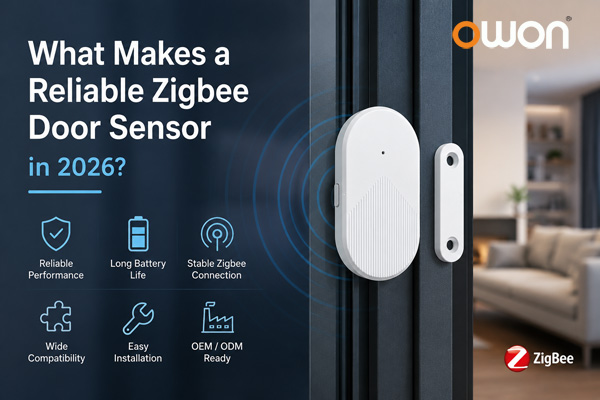
A reliable Zigbee door sensor should provide:
Consistent communication
Stable battery performance
Reliable event reporting
Secure installation
Long product lifecycle support
For system integrators and building operators, predictable performance reduces maintenance requirements and lowers support costs over time.
The demand for smart building technology continues to grow worldwide.
Several trends are expected to increase the importance of door sensors in the coming years:
Buildings are becoming increasingly responsive to real-time occupancy information.
Governments and property owners continue to prioritize energy reduction initiatives.
Platforms such as Home Assistant and Zigbee2MQTT have accelerated adoption of locally controlled devices.
Door sensors are increasingly combined with thermostats, occupancy sensors, lighting controls, and energy monitoring systems to create intelligent environments.
As these trends continue, Zigbee door sensors will remain a foundational component of modern automation systems.
While often considered a simple device, the Zigbee door sensor has evolved into a powerful automation tool.
Its ability to provide real-time status information makes it valuable not only for security but also for energy management, occupancy detection, HVAC control, and smart building operations.
As organizations continue investing in smarter and more efficient buildings, Zigbee door sensors are likely to remain one of the most widely deployed sensing technologies in the IoT ecosystem.
For companies developing smart home, smart hotel, or building automation solutions, choosing reliable hardware is just as important as selecting the right software platform.
Manufacturers such as OWON Technology provide Zigbee door sensors, gateways, thermostats, occupancy sensors, and other IoT devices designed for OEM, system integration, and large-scale deployment projects worldwide.
Copyright:@2020-2021

Comments Please sign in or sign up to post.
0
0 of 500 characters used