
As smart homes and smart buildings continue to evolve, the demand for environmental awareness is growing rapidly.
Modern automation systems no longer rely on a single sensor to detect one condition. Instead, they increasingly use zigbee multi sensor devices that combine several sensing functions into one compact wireless product.
By collecting multiple data points from a single location, these sensors help improve automation accuracy, reduce installation costs, and simplify system deployment.
Today, Zigbee multi sensors are widely used in smart homes, offices, hotels, healthcare facilities, and commercial buildings.
A zigbee multi sensor is a wireless device that combines two or more sensing functions into a single product.
Depending on the model, a sensor may include:
Motion detection
Temperature sensing
Humidity monitoring
Illuminance (lux) sensing
Vibration detection
External temperature probe support
Instead of installing several individual sensors throughout a room, users can obtain multiple environmental measurements from a single device.
This reduces hardware costs, simplifies deployment, and improves overall system efficiency.
Some products are commonly referred to as a zigbee multi sensor 4 in 1 because they combine motion detection, temperature sensing, humidity monitoring, and light measurement within a single wireless device.
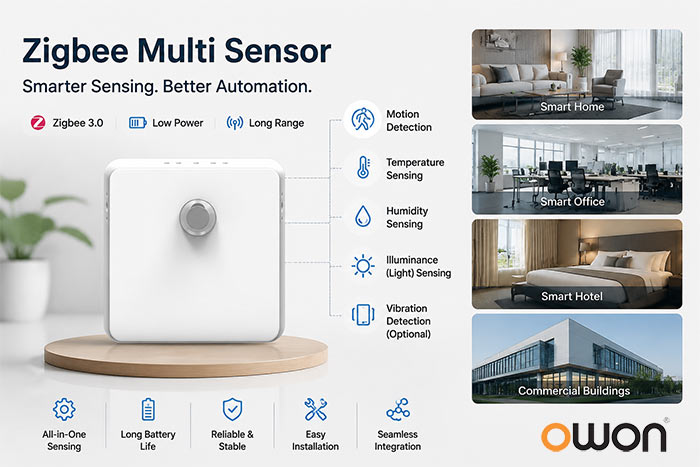
A Zigbee multi sensor continuously monitors its environment and transmits data through a Zigbee 3.0 wireless network.
The sensor collects information such as:
Whether people are moving in the room
Indoor temperature
Relative humidity
Ambient light level
Vibration or tamper events
This information is then transmitted to a Zigbee gateway, home automation platform, building management system, or cloud application where automation rules can be executed.
For example:
Turn lights on when motion is detected
Reduce HVAC operation when a room becomes vacant
Adjust blinds based on ambient light levels
Trigger alerts if abnormal vibration is detected
Generate environmental reports for facility management
By combining multiple environmental measurements, a single sensor can help create smarter automation decisions.
The growing popularity of Zigbee multi sensors is largely driven by the need for simpler and more intelligent automation systems.
Instead of installing separate motion, temperature, humidity, and light sensors, users can deploy a single device that performs multiple monitoring functions.
Fewer devices mean fewer batteries to replace and fewer components to maintain over time.
Combining multiple data sources allows automation systems to make more informed decisions rather than relying on a single trigger.
Using one multi-function device often reduces hardware, installation, and maintenance costs.
Different projects require different sensor combinations.
Among them, the zigbee multi sensor 4 in 1 category has become particularly popular because it delivers multiple environmental measurements from a single wireless device.
This is one of the most widely used configurations.
For example, a sensor such as OWON's PIR313 can combine motion detection, temperature sensing, humidity monitoring, and illuminance measurement within a single Zigbee device.
This type of sensor is commonly used for:
Smart lighting automation
Occupancy-based control
Energy-saving projects
Indoor environmental monitoring
Commercial buildings and industrial environments often require vibration monitoring in addition to occupancy sensing.
For example, a device such as OWON's PIR323 can combine motion detection with temperature, humidity, and optional vibration sensing to support more advanced automation scenarios.
Applications may include:
Smart buildings
Equipment monitoring
Hotel automation
Building energy management
Some projects require temperature measurements inside equipment cabinets, water tanks, refrigeration units, or underfloor heating systems.
In these situations, a zigbee temperature sensor with probe can provide more accurate measurements than standard room sensors.
Homeowners use Zigbee multi sensors to automate lighting, HVAC systems, curtains, and energy-saving routines.
For example, motion and light data can be combined to automatically activate lighting only when people are present and ambient light levels are low.
Hotels increasingly rely on occupancy-based automation to reduce energy waste.
A door sensor can detect room exit while a Zigbee multi sensor verifies whether the room remains occupied. If no activity is detected for a defined period, the system can automatically place the thermostat into an energy-saving mode.
This approach helps improve operational efficiency while maintaining guest comfort.
Facility managers use environmental monitoring to optimize comfort, improve space utilization, and reduce operational costs.
Temperature, humidity, occupancy, and environmental data can help improve comfort and provide additional visibility into building conditions.
Most Zigbee multi sensors are designed for simple deployment.
Typical installation steps include:
Select an appropriate monitoring location.
Mount the sensor on a wall, ceiling, or flat surface.
Pair the device with a Zigbee gateway.
Configure reporting intervals and automation rules.
Verify communication quality and detection coverage.
Because Zigbee supports mesh networking, network coverage can be expanded through compatible routers, gateways, or powered Zigbee devices.
Before selecting a sensor, consider the following questions:
Which measurements are required?
Is motion detection necessary?
Is light sensing important?
Is vibration monitoring needed?
Does the project require an external temperature probe?
Which Zigbee ecosystem will be used?
For users building automation systems based on Tuya platforms, a tuya zigbee multi sensor may be preferred because it can integrate directly into Tuya-enabled smart home and building automation environments.
The best solution is not necessarily the one with the most functions, but the one that best matches the project's operational requirements.
The Zigbee ecosystem includes smart home brands, industrial sensor providers, system integrators, and OEM manufacturers.
For companies developing their own IoT products or automation solutions, working directly with an experienced manufacturer often provides greater flexibility in customization, branding, firmware development, and system integration.
For example, manufacturers such as OWON Technology provide a range of Zigbee sensing solutions, including motion, temperature, humidity, illuminance, vibration, occupancy, and probe-based environmental monitoring devices.
When evaluating suppliers, it is useful to consider:
Zigbee 3.0 compliance
Platform compatibility
OEM/ODM capabilities
Product certifications
Technical support
Long-term product availability
As smart buildings become more data-driven, multi-function sensing devices are expected to play an increasingly important role.
Future developments may include:
More advanced occupancy analytics
Improved battery life
AI-assisted automation
Enhanced environmental monitoring
Deeper integration with energy management systems
By collecting richer environmental data, multi sensors help building operators make more informed decisions while improving comfort and efficiency.
As automation systems become more intelligent, the ability to collect multiple environmental data points from a single device is becoming increasingly valuable.
A zigbee multi sensor simplifies deployment, improves automation accuracy, and reduces overall system costs.
Whether used in smart homes, hotels, offices, healthcare facilities, or commercial buildings, Zigbee multi sensors are becoming one of the most practical building blocks of modern IoT projects.
For applications requiring motion detection, temperature monitoring, humidity sensing, light measurement, or vibration monitoring, today's zigbee multi sensor 4 in 1 solutions provide a flexible and scalable approach to smart building automation.
Previous: None.
Next: Custom Vending Machine Manufacturer: How to Communicate Your Spec Clearly
Copyright:@2020-2021

Comments Please sign in or sign up to post.
0
0 of 500 characters used