
When selecting equipment for material strength testing, many laboratories and manufacturers ask the same question: Can a universal testing machine replace a compression testing machine? The answer depends on the type of material, testing standards, load capacity, and accuracy requirements.
While a universal testing machine (UTM) offers exceptional versatility, Compression Testing Machines remain the preferred choice for heavy-duty compression applications such as concrete, cement, masonry, and construction materials. Understanding the differences will help you choose the right equipment for your testing needs.
In this guide, we'll compare both machines, explain their advantages, and help you determine which solution best fits your laboratory. HBJF provides reliable testing equipment designed to meet international standards for research institutions, quality control laboratories, and industrial manufacturers.
A Universal Testing Machine (UTM) is a multifunctional testing system capable of performing various mechanical tests, including:
Measures tensile strength, yield strength, elongation, and breaking force.
Evaluates compressive strength for smaller specimens or materials with moderate testing loads.
Determines flexural strength and modulus of elasticity.
Commonly used for plastics, metals, composites, rubber, adhesives, and packaging materials.
Because one machine performs multiple tests, UTMs are widely used in research laboratories and manufacturing quality control.
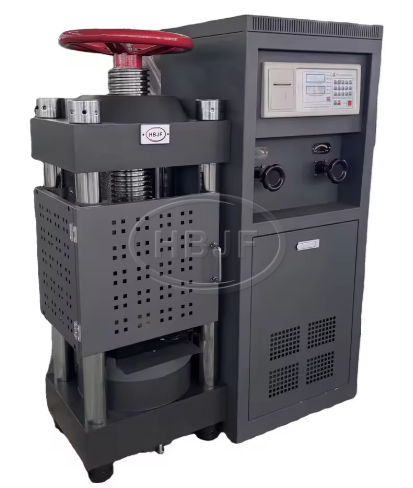
A compression testing machine is specifically engineered to measure the compressive strength of materials under high loads.
Unlike a UTM, its structure is optimized solely for compression testing, providing greater rigidity, stability, and higher maximum load capacity.
Typical applications include:
Testing compressive strength according to construction standards.
Evaluating cement quality and structural performance.
Determining the load-bearing capacity of building materials.
Testing geological samples for mining and civil engineering.
HBJF manufactures advanced Compression Testing Machines suitable for demanding construction and infrastructure projects.
Universal Testing Machines are versatile and perform multiple types of mechanical testing.
Compression Testing Machines focus exclusively on compression testing, making them highly specialized.
UTMs commonly offer capacities ranging from several kilonewtons up to several hundred kilonewtons.
Compression Testing Machines often reach capacities of:
· 300 kN
· 600 kN
· 1000 kN
· 2000 kN
· 3000 kN
· 5000 kN
These higher capacities make them ideal for testing concrete and other heavy construction materials.
Compression Testing Machines feature:
· Heavy-duty frames
· Reinforced loading platens
· Superior alignment accuracy
· Increased structural rigidity
These features minimize deformation during high-load testing.
Many construction standards specifically require dedicated compression testing equipment.
Examples include:
· ASTM
· ISO
· EN
· BS
· AASHTO
Using the correct equipment helps laboratories maintain accreditation and compliance.
A Universal Testing Machine can replace a compression testing machine when:
Examples include:
· Plastics
· Rubber
· Wood
· Small metal components
· Composite materials
If the required testing force falls within the UTM's capacity, reliable compression results can be achieved.
Research laboratories often prefer one machine capable of performing several testing methods to reduce equipment investment.
Concrete specimens frequently require loads exceeding 1000 kN.
Dedicated Compression Testing Machines deliver the necessary capacity safely and accurately.
Construction material manufacturers often perform hundreds of compression tests daily.
Dedicated machines provide:
· Faster workflows
· Greater durability
· Lower maintenance
· Improved long-term reliability
Many certification agencies specify dedicated compression equipment for official strength testing.
Using the appropriate machine helps avoid compliance issues.
Rigid machine construction minimizes frame deformation, improving measurement precision.
Since the machine performs only compression testing, wear is concentrated on fewer components, extending equipment life.
Heavy-duty hydraulic systems and reinforced frames enhance operator safety during high-load testing.
Consistent loading conditions produce highly repeatable test results, which are essential for quality control.
Although dedicated compression systems excel in specific applications, Universal Testing Machines offer several important benefits.
One machine can perform multiple mechanical tests, reducing laboratory equipment costs.
Instead of purchasing separate machines for tensile, compression, and bending tests, laboratories can install a single UTM.
Fewer machines simplify calibration, maintenance, and operator training.
The right choice depends on your testing requirements.
A Universal Testing Machine is suitable if you:
· Test multiple material types
· Require tensile, compression, and flexural testing
· Work with lower compression loads
· Operate a research or educational laboratory
A dedicated Compression Testing Machine is recommended if you:
· Test concrete, cement, bricks, or structural materials
· Need high-capacity loading
· Perform frequent compression testing
· Must comply with construction industry standards
HBJF offers both universal testing systems and professional Compression Testing Machines, enabling laboratories to select equipment tailored to their applications, testing standards, and production requirements.
HBJF is committed to providing reliable, high-performance material testing equipment for laboratories, universities, construction companies, and quality inspection agencies worldwide.
HBJF products offer:
Modern software enables precise load control, real-time data acquisition, and automatic result generation.
Accurate load measurement ensures dependable and repeatable testing outcomes.
Heavy-duty steel frames provide long-term stability under demanding testing conditions.
HBJF equipment is designed to meet widely recognized ASTM, ISO, EN, and other industry testing requirements.
With professional technical support and dependable product quality, HBJF helps customers achieve accurate material testing while improving laboratory efficiency.
A Universal Testing Machine can replace a compression testing machine for light-duty and multi-purpose applications. However, when testing high-strength construction materials or performing routine heavy-load compression tests, dedicated Compression Testing Machines remain the superior choice.
Their higher load capacity, specialized design, greater accuracy, and compliance with industry standards make them indispensable for construction material testing laboratories. By choosing the right equipment from HBJF, organizations can ensure reliable results, improve operational efficiency, and maintain confidence in every compression test.
Previous: Friction Stir Welding Machine Ensures Defect-Free Joints for Critical Aluminium Structures
Next: How to Measure In-Situ Compaction Density with a Sand Density Cone
Copyright:@2020-2021

Comments Please sign in or sign up to post.
0
0 of 500 characters used