
In industrial filtration, selecting the right metal filter media is essential for achieving the best balance of filtration efficiency, flow performance, and service life. Two of the most widely used materials in metal filtration are sintered metal fiber felt and woven sintered mesh. Both are commonly used in stainless steel filter cartridges, but they differ significantly in structure, performance, and ideal application.
Understanding the differences between these two filter media helps engineers choose the right filtration solution for specific industrial processes. For high-performance industrial applications, ZHUAN LV provides advanced stainless steel filter cartridges designed with both sintered metal fiber felt and woven sintered mesh options.
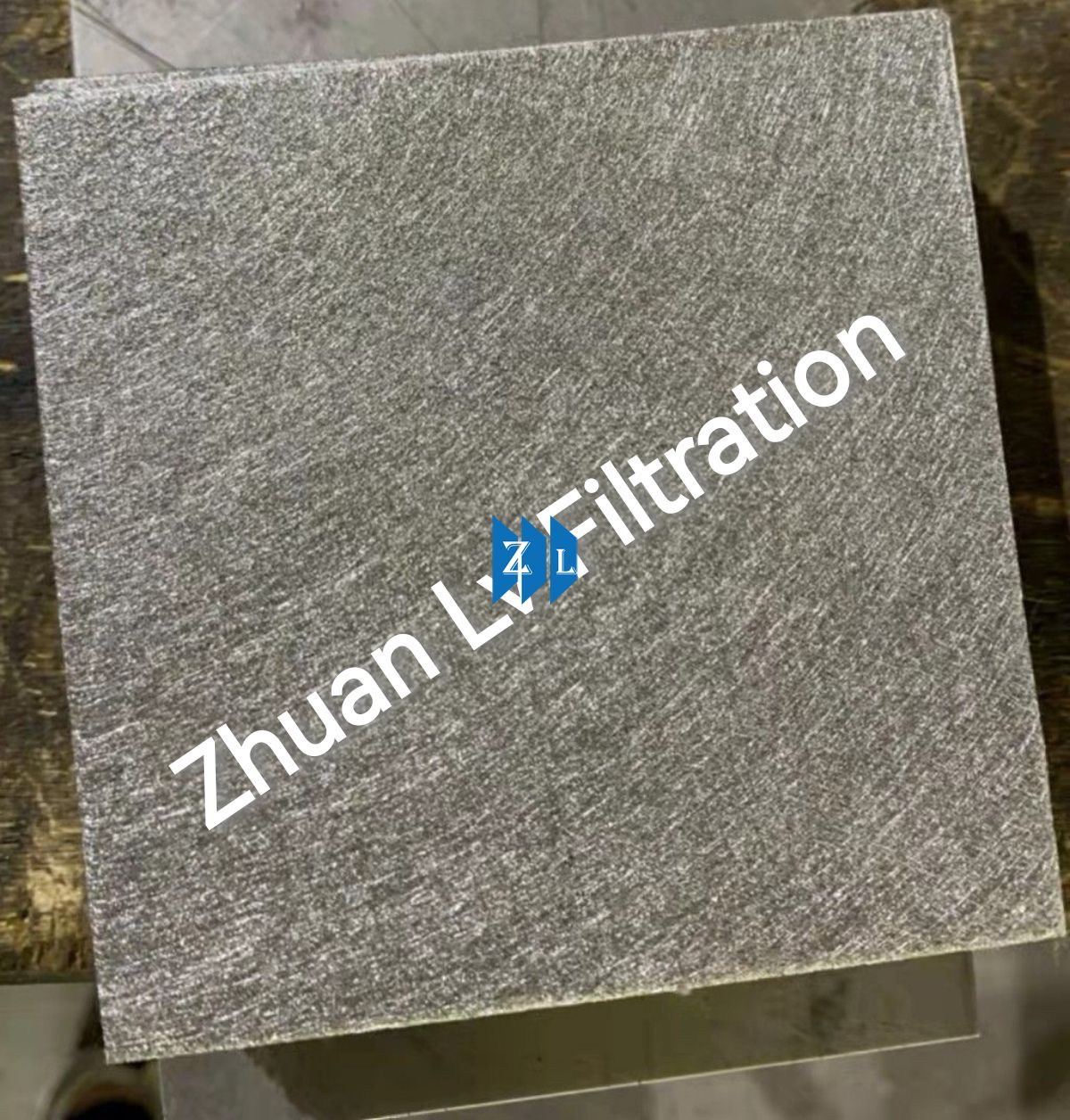
Sintered metal fiber felt is a porous filtration material made by randomly laying fine stainless steel fibers into a web and then sintering them together at high temperature. The result is a three-dimensional porous structure with high porosity and excellent dirt-holding capacity.
Unlike woven mesh, the fibers in sintered metal fiber felt are arranged in a non-directional structure, creating a deep filtration medium with complex flow paths.
Sintered metal fiber felt offers several performance advantages:
· High porosity
· Deep-layer filtration
· Excellent dirt-holding capacity
· Low pressure drop
· High permeability
· Good thermal resistance
Because of these characteristics, sintered metal fiber felt is often used in fine filtration and high-flow applications.
Woven sintered mesh is made by stacking multiple layers of woven stainless steel wire mesh and sintering them into one rigid porous structure. This creates a strong, uniform filtration medium with precise pore control and excellent mechanical strength.
Most stainless steel filter cartridges using woven sintered mesh are built with multi-layer mesh structures, such as 5-layer sintered mesh, to improve filtration stability and durability.
Woven sintered mesh is known for:
· Precise filtration accuracy
· Strong mechanical strength
· Stable pore structure
· Excellent pressure resistance
· Easy cleaning
· Long service life
This makes woven sintered mesh ideal for high-pressure and precision filtration systems.
The main difference between sintered metal fiber felt and woven sintered mesh lies in their internal structure.
Sintered metal fiber felt has a random, three-dimensional fiber network. This creates a deep filtration path where particles are trapped throughout the media thickness.
This structure improves dirt-holding capacity and allows high contaminant retention before pressure drop increases significantly.
Woven sintered mesh has a more uniform and layered structure. It uses woven wire mesh layers bonded together to create a controlled filtration path.
This structure provides more consistent pore size and better dimensional stability.
Both media perform well, but their filtration mechanisms differ.
Sintered metal fiber felt performs deep filtration. Particles are captured not only on the surface but also within the thickness of the media.
This gives it:
· Higher dirt-holding capacity
· Better retention of fine particles
· Longer filtration cycles in dirty systems
For applications with heavy contaminant loads, sintered metal fiber felt often performs better.
Woven sintered mesh performs more controlled surface and depth filtration, depending on its layer design.
It offers:
· More accurate micron control
· Better pore consistency
· More predictable filtration efficiency
For precision filtration, woven sintered mesh often provides better accuracy.
Durability is a major factor in industrial filtration.
Sintered metal fiber felt has excellent thermal resistance and good corrosion resistance, but its fiber-based structure is generally less mechanically rigid than woven mesh.
It performs well in controlled operating conditions but may be less resistant to extreme mechanical stress.
Woven sintered mesh offers superior mechanical strength because of its rigid wire mesh structure.
This makes stainless steel filter cartridges using woven sintered mesh more resistant to:
· High pressure
· Mechanical shock
· Backwash stress
· Repeated cleaning cycles
For harsh industrial environments, woven sintered mesh is generally more durable.
Both materials are reusable, but cleaning behavior differs.
Sintered metal fiber felt can be cleaned and reused, but its deep filtration structure may trap contaminants more deeply, making cleaning more difficult in some applications.
Woven sintered mesh is generally easier to clean because contaminants are less likely to penetrate deeply into the media.
This makes stainless steel filter cartridges with woven sintered mesh easier to regenerate and maintain.
Each filter media is better suited for different industrial applications.
Sintered metal fiber felt is ideal for:
· Fine particle filtration
· High dirt-load systems
· Polymer filtration
· Gas filtration
· Steam filtration
Woven sintered mesh is ideal for:
· High-pressure filtration
· Precision liquid filtration
· Hydraulic systems
· Chemical processing
· Reusable industrial filtration
The better option depends on the application.
Choose sintered metal fiber felt when high dirt-holding capacity, deep filtration, and low pressure drop are the top priorities.
Choose woven sintered mesh when precise filtration accuracy, mechanical strength, and easier cleaning are more important.
ZHUAN LV manufactures high-quality stainless steel filter cartridges using both sintered metal fiber felt and woven sintered mesh, helping industrial users select the right filtration solution for their process needs.
In the comparison of sintered metal fiber felt vs woven sintered mesh, both materials offer distinct advantages. Sintered metal fiber felt excels in deep filtration and contaminant holding, while woven sintered mesh offers better strength, accuracy, and cleanability.
For industrial users seeking reliable stainless steel filter cartridges, ZHUAN LV delivers advanced metal filtration solutions engineered for performance, durability, and long-term efficiency.
Previous: When to Use Threaded Pipe Fittings vs Grooved Systems Based on Pipe Diameter and Application
Copyright:@2020-2021

Comments Please sign in or sign up to post.
0
0 of 500 characters used